Friday, March 9, 2012

Two Sides of Marine Life

This entry starts with seaweed, one of the most basic forms of life in the sea, and ends with two important species of marine mammals for the Pacific Northwest. 

Eelgrass: green, grass-like blades about 1/2 inch wide and 3 feet long. Eelgrass is found submerged or floating primarily in colonies. These colonies are referred to as eelgrass "beds". 

Eelgrass grows in the muddy or sandy substrate of the shallow sub-tidal zone, down to a depth of approximately 22 feet in the Northwest.  Eelgrass fills an important function in the marine foodweb at two levels: it is directly consumed by organisms such as waterfowl, urchins, worms, snails, and microorganisms. In addition, many other species (such as salmon, crabs, and heron) consume the organisms that live in the eelgrass colonies.
Eelgrass can also protect animals from overheating caused by exposure to solar rays in shallow water during low tides and in shallow areas. On tidelands, animals bury themselves underneath mats of eelgrass to avoid dehydration.  Eelgrass has historically been used for a variety of human needs such as food, basket weaving, compost, bedding, insulation and high-grade paper. Most industries stopped processing eelgrass in 1930-31 when the Wasting Disease nearly wiped out eelgrass populations along the Atlantic Coast of North America and Europe.
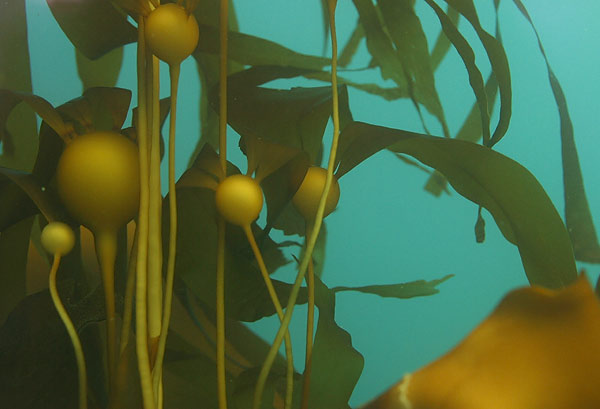
Bull kelp: Bull kelp is best known for the long, smooth, brown bull whips that wash up on beaches in fall and winter. This long stipe, or stalk, leads on one end to a bulbous gas float, attached to long, flat, leaf-like blades. At the other end of the stipe is a holdfast - a disc-shaped, root-like structure that adheres to rocky substrates at depths to 60 feet. Bull kelp is found in the turbid subtidal waters of ocean coasts and straits. The fastest growing seaweed in the world, bull kelp can grow from a tiny spore to a 120 foot mature plant in a single season. On the blades of mature kelp, spore-forming patches, called sori, develop and sluff off, leaving holes or notches in aging blades. These heavy patches often fall near the parent's base, but some may drift a distance to release their spores in new territories. Kelp typically break from their holdfast during fall storms, die and wash up onto beaches, ending their life after just one season. The calmed waters of the kelp beds serve as refuges for seabirds such as ducks, grebes and gulls which also take advantage of the food reserves within. Kelp does not recover well from harvest so kelp is protected from collection. An important economic value of kelp forests has been the habitat provided for salmon, herring and other forage fish, which have been commercially harvested.

Sargassum: A disc-shaped holdfast glues the bushy alga to the substrate. From this base grow several stalks, or fronds, often over three feet long with alternating leafy branches. Among the golden-brown, leaf-like blades are pea-size floats, or vesicles, and similarly shaped reproductive organs. Sargassum's vigorous spread upon arrival in the Pacific Northwest may be due to simple but effective methods of reproduction and dispersal. Each individual plant contains both male and female reproductive parts. Once fertilized, the heavy offspring fall off, usually settling within a few feet of the parent. 
Sargassum can be found colonizing rocky substrates in lower intertidal and shallow subtidal habitats. The rapid growth of this algae, along with its ability to reproduce in a single season allows it to establish itself quickly, particularly in disturbed areas of sheltered bays that provide open substrate for offspring to settle and mature. Once established, Sargassum reduces abundance of native algae by shading.
The ecological impact of Sargassum is not fully known. On one hand, the complex branching of the fronds provides habitat for large numbers of grazing small creatures that are in turn fed upon by other species. As with eelgrass and kelp, Sargassum provides spawning surfaces for Pacific herring, which lay eggs on the blades. However, where habitats overlap, aggressive colonization by Sargassum shades out eelgrass, kelp and other native algae - vital habitat for juvenile salmon, forage fish, and other marine species. The harvest of sea-weeds is not allowed because of marine vegetation's vital role in providing habitat to important species.

Habor Seals: Harbor seals use specific shoreline areas on a regular basis to haul-out of the water and rest. These resting areas are called seal haul-outs and include beaches, rocky areas, log booms and floats. Time spent on the haul-out is essential for their survival as they rest, dry out, interact and regulate their body temperature. In addition to resting, Harbor seals give birth to and nurse their pups on the haul-out, and undergo an annual molt of their pelage or fur. 
As we approach the months of March through June, harbor seal presence and activities will intensify leading up to the late-June to mid-August popping season. The early weeks are challenging for many baby animals, and seals are no exception. During this time period, mortality rates for harbor seals can reach as high as 50 percent. The NMFS marine mammal viewing guidelines mandate a minimum approach distance of 100 yards. The approach distance will reduce the potential for disturbing or stressing a resting or injured animal.

Orca Whales: Dorsal fins are curved in females and immature males, and become straight and triangular, reaching a height of up to 6 feet in mature males. Males grow to a length of 30 feet and can weigh over 8 tons.  Females grow to 24 feet long and usually weigh over 4 tons.
Orcas begin reproducing in their mid-teens. Females have a gestation period of 17 months. They give birth to a single calf that is usually about 7 feet long and weighs 400 pounds. Orcas will give birth at 4-6 year intervals having a total of 4-6 calves throughout their lifetime. Resident calves stay with their mothers in the same pod for the rest of their life. There are three pods (J, K, and L) with a total of 90 members in the Southern Resident Pacific Northwest community.
Pods are extended families that range in size from a few to 50 members. Whales always stay within their pod; they move, hunt and play as a group.  Each pod can communicate over several miles with its own “dialect” of calls, shrieks, and whistles.  A few times during the summer and early fall, all the pods in the Southern Resident community come together to form a “superpod”.  In addition to socializing, one main function of the superpod is reproduction.  Adults mate with adults from other pods.  This ensures genetic diversity and protects against inbreeding.
Scientists have described three population categories of orcas —residents, transients and offshores. Residents hunt in large groups, eat fish, and have a total range of about 500 miles. Transients eat marine mammals (such as seals, sea lions, dolphins, and whales), travel in smaller groups, and have a range of about 900 miles.  The offshore orcas are usually found 10 to 30 miles off the coast from California to Alaska and tend to travel in groups of 30 or more.  Very little is known about offshores, except that they possibly eat schooling fish.  
Orcas engage in a variety of behaviors, such as breaching and spyhopping. A whale is considered breaching if 2/3 of its body is out of the water.  This activity is often seen during times of socializing and foraging.  When spyhopping, an orca raises its head vertically out of the water. Orca whales have excellent eyesight and it is believed that spyhopping is a way for them to look at their surroundings.
On average, females live 50 years and have been known to live up to 80 or 90 years.  Males have a much higher mortality rate and usually live 30 years with a maximum lifespan of 50 to 60 years.
The population of orcas was hurt in 1960s and 1970s, when many juveniles were captured for use in live displays in oceanariums. The population slowly recovered in the late 1990's, however, the population quickly declined in 2001 and was due to a variety of factors, including decline of salmon stocks (a main food source), bioaccumulation of toxins in their blubber, and pressures of the whale-watching industry.   In April 2004, Washington’s Fish and Wildlife Commission listed the Southern Resident orcas, along with transients and offshores, as endangered species. The Southern Resident community has recently been listed as “endangered” under the Endangered Species Act.  As of late summer, 2005, there are 90 orcas in the Southern Resident Area.

Wednesday, March 7, 2012

Birds of the Northwest

I'm leaving next week to Orcas Island, Washington, to be an environmental educator at an outdoor camp. In preparation, I compiled a list of common flora and fauna of the Pacific Northwest and figured I might as well share it with my billions of readers out there. It seemed best to start with the kingdom of birds, because Emily Dickinson would have wanted it that way: "I hope you love birds too. It is economical. It saves going to heaven." 


Most of this information is copied word-for-word from various county websites in the Northwest. 


Great Blue Heron (blue crane, gray crane, big cranky): common sight near many wetlands, forests and estuaries in Washington. In flight the great blue heron slowly beats its 7-foot wingspan, head folded back on shoulders, long legs trailing in the behind. If startled it will emit a low-pitched squawk. It feeds by day or night but is most active before dawn and dusk. The great blue heron is an opportunistic predator who eats small fish, shellfish, insects, reptiles and amphibians and even small mammals and birds.


Common Loons: Common loons once were described as a fairly prevalent breeding species both east and west of the Cascade crest but likely declined between the late 1800’s and early 1900’s throughout the Pacific Northwest. A number of lakes in the Pacific Northwest appear to have offered ideal conditions for loon nesting in the past. Although it currently is a common migrant and wintering species within the area, it rarely breeds here. For several years common loons have either attempted to nest or nested in some protected watersheds in the Pacific Northwest. 


Burrowing Owls:
Burrowing owls are a charismatic species favored among many wildlife watchers. They can be found in grasslands, rangelands, agricultural areas, deserts, or any other open dry area with low vegetation. Unlike most owls, Burrowing Owls are often active during the day, although they tend to avoid the midday heat. Burrowing Owls mainly eat large insects and small rodents. Before European colonization, Burrowing Owls probably inhabited every suitable area of the New World, but in North America they have experienced some restrictions in distribution since.


Osprey: Body color is dark brown above and white below. Head is white except for a brown stripe from the eye to the back of the head. The tail has medium-sized, dark brown and white bands. The female Osprey has a ring of brown spots around her neck. The Osprey in flight can be misidentified as a large gull or even a Bald Eagle. The Osprey's wings are broader and the wing tips are not as pointed as a gull's. The Bald Eagle has broader wings and a larger wingspan. While in flight, large dark patches at the birds' "wrist" and crooked wings help distinguish this bird from other species.

The Osprey is one of the world's most widespread birds, occurring on all continents except Antarctica and many islands. Originally, it nested widely across North America, but contamination with the pesticide DDT led to population decrease and range reduction. The Osprey is rarely seen far from water, except during migration. It eats primarily fish but on occasion has been known to eat snakes, amphibians, and smaller vertebrates. It generally soars over the water searching for prey. When the prey is located, it dives and strikes it with its talons. Instances are known of Ospreys diving on fish too large for them, getting their talons stuck in the fish's flesh, and being dragged under the water and drowned.


Vaux’s Swift:
Vaux's swift is the smallest of the four species of swifts in North America.  Vaux’s swifts are approximately 5 inches long and are most closely related to hummingbirds.
Vaux’s swifts spend the majority of their day in the air feeding on flying insects.  A single swift may consume as many as 20,000 insects in a single day.  Unlike most birds Vaux’s swifts do not have a back talon, so they cannot perch on tree limbs and are most effective at clinging to the rough interior surfaces of hollow trees or rough brick-lined chimneys in urban areas for shelter.  Within these hollow spaces, referred to as roosts, a few thousand to several thousand swifts can concentrate as they make their spring or fall migrations.  Their roosting sites and movements constitute one of the great migration wonders of the natural world.


Bald eagle: When mature, bald eagles develop their recognized coloring of a brownish-black body, white head and tail, and yellow bill. Immature eagles have a dusky brown head and tail, a brownish bill, and blotches of white and cream on the body. As with most birds of prey, females are larger than males. Females are larger than males, and can reach a length of 43 inches and have a wingspan of 92 inches. The bald eagle is only present on the North American continent.
Bald eagles are both hunters and scavengers. They hunt fish, waterfowl and mammals, and scavenge from elk, deer and whale carcasses and roadkill. Bald eagles are great hunters for several reasons: they have excellent eyesight, they can perceive depth very well, and their ability to see details at a distance is 3 to 4 times greater than humans. Their razor sharp talons immediately contract upon contact with prey, and little spikes on the bottom of their feet make it easier to pick up slippery fish. Eagles’ bones weigh less than half the total weight of their 7,000 feathers, which makes it easier to gain altitude and glide as they search for prey. Food supply is the major dictator of bald eagle migration patterns. Pairs will migrate north in the early fall to get food in northern British Columbia and southeast Alaska. In the late fall, bald eagles from all over western North America migrate to Washington for the milder weather and food supply. When breeding season begins, bald eagles will return to their same breeding area and often the same nest each year.
Eagles display a variety of behaviors, mostly used as a form of communication between each other. During the winter, hundreds of bald eagles will often roost together in the night. The communal roosts occur in sheltered areas, helping the eagles conserve energy. These roosts may also serve a role in pair bond formation and communication about foraging sites. Bald eagles are estimated to live at least 28 years in the wild; deaths at a younger age are usually directly attributable to humans or human activities.
Bald eagles in Washington have made a comeback from a low of 105 nesting pairs in 1980 to 605 pairs in 2001. During the winter months when bald eagles from all over western North America migrate to Washington, the population increases to about 4,500. When Lewis and Clark visited Washington 200 years ago, the estimated bald eagle population was 6,000 to 10,000. Yet the Bald eagle is still listed as a "threatened" species.

Scoters:  Scoters are particularly abundant on Washington seas during winter months when the velvet black males and dark-chocolate brown females are often seen swimming offshore in large groups, or “rafts”. Scoters build nests on the ground at the edges of lakes, rivers and wetlands with each species having slightly different preference of nesting habitat. Scoters form pair bonds in winter areas or during spring migration, which are maintained and defended by males until incubation of eggs begins, at which point males fly off. 
Often seen swimming along the surf, scoters dive for blue mussels, crabs, clams and other invertebrates. 
Washington's scoter population is estimated to have declined by 50% in the last two decades. A large scale die-off in the 1990's occurred in Southeast Alaska and although the cause is unknown, contaminants are suspected. Reasons for decline in Washington are not known, but possibilities include:
  • Vulnerability to oil spills: Scoter populations concentrate in nearshore areas where spills typically occur. Birds caught in oil nearly always die due to hypothermia or poisoning.
  • Susceptibility to toxins accumulating in their foods: Cadmium, lead and PCP's are filtered by shellfish, then eaten by the diving duck, accumulating in the fatty tissue.
  • The decline of spawning forage fish means less roe available to migrating scoters

Thursday, December 1, 2011

Geology

It happens too often that a six-year old whom I'm nannying asks me something like, "Where does lightning come from?" and I shamefully respond, "Uhhh... it's, you know, it comes from the air... and it's electricity.... something like that." It's exactly like in these Calvin and Hobbes cartoons:


Eventually you start giving answers like these:

So I've decided to write a series of entries that will modestly explain various natural processes. This is not merely to improve my reputation among curious six year-olds, but also to help anyone out there who needs a review of this material, as well.

This entry is about geology. I'll start with a startle: a reminder of our place in geologic time. See the diagram below...


We all know that there are three main geologic layers to our planet: the crust, mantle, and core. The crust is less than 1% of the Earth's mass and consists of oxygen, magnesium aluminum, silicon calcium, sodium potassium, and iron. The mantle is a solid casing and makes up 70% of the Earth's mass. It's made of silicon, oxygen, aluminum and iron. The core is 30% of the planet's mass and consists of iron and nickel. The outer core is liquid and the inner core is solid.


Now for the most important factor in geology: rocks. There are three main types of rocks: igneous, sedimentary, and metamorphic, and they all partake in the "rock cycle," by taking form, wearing down, and forming again. Igneous rock is formed by solidified magma (hence it's name, meaning formed by heat). It's shaped how we normally think of a rock-- as a boulder, stone, or pebble. For example, this quartz rock:

Here comes a fork in road, where the igneous rock can either become sedimentary rock or metamorphic rock. If it becomes sedimentary, then with erosion by wind or water it will break down into sediment. That sediment compacts over time into sedimentary rock, which usually contains a good amount of fossils. Seventy-five percent of the crust's rock is sedimentary. Have a look at the layers of sedimentary rock in my Grand Canyon photos from this summer:


If the igenous' destiny be metamorphic, it will be affected by heat and pressure and subsequently have its mineral content transformed. But whichever road that little igneous takes, he still has the opportunity to walk the road not taken, as sedimentary rock can be affected by heat and pressure to become metamorphic rock, and metamorphic rock can be exposed to erosion and redeposited as sedimentary rock. Moreover, all three types of rock can return to their birthplace, as their re-melting produces magma from which new igneous rocks can form. 

But what exactly is a rock? Is it always naturally formed and composed of minerals? Nope. Man makes rock, such as concrete or brick. And many rocks don't contain a trace of minerals, such as coal, obsidian, or the aforementioned concrete. Now I'm hearing that six year-old saying, "what's a mineral?" The short answer is that it is something natural, solid, and not resembling life in the least (aka without carbon compounds). There are three thousand different types of minerals in the world. Most rocks are made of more than two types of minerals.

Some photos of common types of rocks and minerals: 

Minerals
Feldspar

Calcite

Quartz
Iron
Igneous rocks

Granite (contains feldspar, quartz, and mica): 

Carving Mount Rushmore out of granite


Basalt is the most common rock on Earth. It is formed by rapidly cooling lava:  
Columnar Basalt in Turkey
Diorite is found all through the Sierras and contains feldspar and one or more dark minerals, with the feldspar dominant:


Gabbro contains feldspar and one or more dark minerals with the dark mineral dominant:

Periodotite makes up majority of Earth's mantle and contains mostly iron:

Pumice is formed when lava dries containing air bubbles. It is the only rock that floats:
Sedimentary Rocks

Coal does not contain minerals, but rather consists of carbon. It forms in areas where many decomposed plants and fossils are present. For example, there is a lot of coal and other natural fuels in Canada because a large sea once covered that area and the climate was tropical. 

Shale is hardened clay. It often breaks off into large flat sections.
Sandstone is a soft stone that is usually deposited as many different beautiful layers of sand.


Limestone contains calcium carbonate and lots of fossils, often seashells. This is prevalent in my seaside hometown of Santa Cruz, the most important limestone mining and processing area in the United States during the 19th century.

Metamorphic Rocks


Slate is transformed shale.
Marble is transformed limestone.
 Quartzite is a very hard rock.
Some interesting facts:

  • Feldspars make up almost 50% of the Earth's crust. 
  • Gold is so malleable that you can roll an ounce of it into a hair-thin wire 50 miles long.


  • There are some trails left by sliding rocks in Death Valley, California. How these rocks move is still a mystery, but the favored theory is that wind pushes them along the desert floor. 
  • The biggest pure-gold nugget was found in Australia in 1869 and weighed 156 pounds.
  • Platinum is so rare that two million pounds of ore may contain only one pound of metal. 
  • A geode is a dull piece of igneous or sedimentary rock on the outside with beautiful crystals on the inside. 
  • The Taj Mahal is made entirely out of marble. 
  • Quartz is the most common mineral on Earth. 
  • Sand becomes soil when plants start to sprout in it. In other words, soil is sand mixed with decomposed carbon material. Clay, dirt, mud, silt, dust, and humus are all types of soil.

Hope you learned a bit about the things we encounter every moment of the day... for me, the more educated I am on natural processes, the more I appreciate what I see. I went on a run on the beach after writing this entry and thought about all the waves that have crashed and eroded all those stones and all the lives those stones lived as different species of rock and how far they traveled to get to that beautiful little shell-shaped beach in San Sebastián, Spain. 

Next up, trees!

Thursday, November 10, 2011

Granite Moraine


"Strange to say, these boulders lying so still and deserted, with no moving force near them, no boulder carrier anywhere in sight, were nevertheless brought from a distance, as difference in color and composition shows, quarried and carried and laid down here each in its place; nor have they stirred, most of them, through calm and storm since first they arrived. They look lonely here, strangers in a strange land,--huge blocks, angular mountain chips, the largest twenty or thirty feet in diameter, the chips that Nature has made in modeling her landscapes, fashioning the forms of her mountains and valleys. And with what tool were they quarried and carried? On the pavement we find its marks. The most resisting unweathered portion of the surface is scored and striated in a rigidly parallel way, indicating that the region has been overswept by a glacier from the northeastward, grinding down the general mass of the mountains, scoring and polishing, producing a strange, raw, wiped appearance, and dropping whatever boulders it chanced to be carrying at the time it was melted at the close of the Glacial Period. A fine discovery this." -John Muir


Moraine is any glacial debris of soil or rock. It can be as small as silt or as large as the granite monoliths of Yosemite.


Silt moraine in Yosemite provides some of the best soil in the world. John Muir sums up the process: "As for the forests we have been passing through, they are probably growing on deposits of soil most of which has been laid down by this same ice agent in the form of moraines of different sorts, now in great part disintegrated and outspread by post-glacial weathering."


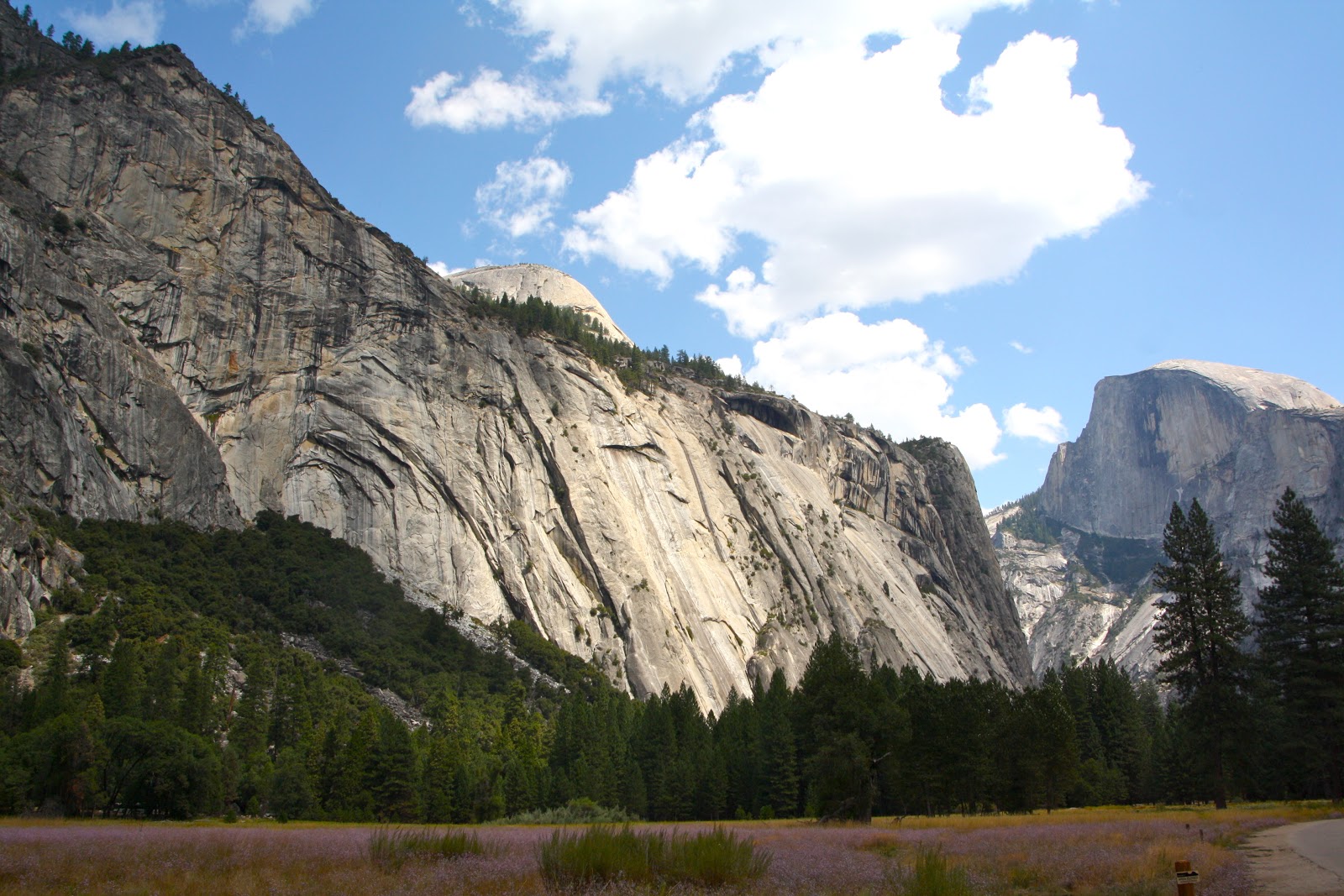
And enormous moraine boulders in Yosemite are the largest granite monoliths in the world: "The great Tissiack, or Half-Dome, rising at the upper end of the valley to a height of nearly a mile, is nobly proportioned and life-like, the most impressive of all the rocks, holding the eye in devout admiration, calling it back again and again from falls or meadows, or even the mountains beyond,--marvelous cliffs, marvelous in sheer dizzy depth and sculpture, types of endurance. Thousands of years have they stood in the sky exposed to rain, snow, frost, earthquake and avalanche, yet they still wear the bloom of youth."


Muir had quite a bit to say about the moraines of stunning Tenaya Lake: 

"All is bare, shining granite, suggesting the Indian name of the lake, Pywiack, meaning shining rock. The basin seems to have been slowly excavated by the ancient glaciers, a marvelous work requiring countless thousands of years."


"Arriving early, I took a walk on the glacier-polished pavements along the north shore, and climbed the magnificent mountain rock at the east end of the lake, now shining in the late afternoon light. Almost every yard of its surface shows the scoring and polishing action of a great glacier that enveloped it and swept heavily over its summit, though it is about two thousand feet high above the lake and ten thousand above sea-level. This majestic, ancient ice-flood came from the eastward, as the scoring and crushing of the surface shows. Even below the waters of the lake the rock in some places is still grooved and polished; the lapping of the waves and their disintegrating action have not as yet obliterated even the superficial marks of glaciation. In climbing the steepest polished places I had to take off shoes and stockings. A fine region this for study of glacial action in mountain-making."

I'm almost positive this is the mountain he is speaking of. It's hard to see at this distance, but there was incredibly wavy scoring in the rock face.


"There is another rock, more striking in form than this, standing isolated at the head of the lake, but it is not more than half as high. It is a knob or knot of burnished granite, perhaps about a thousand feet high, apparently as flawless and strong in structure as a wave-worn pebble, and probably owes its existence to the superior resistance it offered to the action of the overflowing ice-flood."

I am 100% positive this is the rock he is referring to at the head of Tenaya Lake. Today you can see people adventurously climbing it:


Yosemite must be one of the best places in the world to study moraine geology. It's really the foundation for everything that makes Yosemite magnificent and unrivaled.