Thursday, October 13, 2011

Silver Fir

Silver fir, the perfect little Christmas tree
"The principal tree for the first mile or two from camp is the magnificent silver fir, which reaches perfection here both in size and form of individual trees, and in the mode of grouping in groves with open spaces between. So trim and tasteful are these silvery, spiry groves one would fancy they must have been placed in position by some master landscape gardener, their regularity seeming almost conventional. But Nature is the only gardener able to do work so fine. A few noble specimens two hundred feet high occupy central positions in the groups with younger trees around them; and outside of these another circle of yet smaller ones, the whole arranged like tastefully symmetrical bouquets, every tree fitting nicely the place assigned to it as if made especially for it; small roses and eriogonums are usually found blooming on the open spaces about the groves, forming charming pleasure grounds. Higher, the firs gradually become smaller and less perfect, many showing double summits, indicating storm stress. Still, where good moraine soil is found, even on the rim of the lake-basin, specimens one hundred and fifty feet in height and five feet in diameter occur nearly nine thousand feet above the sea. The saplings, I find, are mostly bent with the crushing weight of the winter snow, which at this elevation must be at least eight or ten feet deep, judging by marks on the trees; and this depth of compacted snow is heavy enough to bend and bury young trees twenty or thirty feet in height and hold them down for four or five months. Some are broken; the others spring up when the snow melts and at length attain a size that enables them to withstand the snow pressure. Yet even in trees five feet thick the traces of this early discipline are still plainly to be seen in their curved insteps, and frequently in old dried saplings protruding from the trunk, partially overgrown by the new axis developed from a branch below the break. Yet through all this stress the forest is maintained in marvelous beauty." John Muir, My First Summer in the Sierra
Although the silver, white, and red firs are all different types of trees, their names are often used interchangeably. For example, John Muir calls the silver fir both Abies concolor and Abies magnifica, while biologists today dub the concolor "white fir" and the magnifica "red fir." The silver fir is more commonly known as the Abies Amabalis, though Muir never mentions this Latin name. I had a very difficult time distinguishing between the three and eventually gave up and decided to refer to them all as silver firs, as does Mr. Muir.
"The silver firs (Abies concolor and Abies magnifica) are exceedingly beautiful, especially the magnifica, which becomes more abundant the higher we go. It is of great size, one of the most notable in every way of the giant conifers of the Sierra. I saw specimens that measured seven feet in diameter and over two hundred feet in height, while the average size for what might be called full-grown mature trees can hardly be less than one hundred and eighty or two hundred feet high and five or six feet in diameter; and with these noble dimensions there is a symmetry and perfection of finish not to be seen in any other tree, hereabout at least. The branches are whorled in fives mostly, and stand out from the tall, straight, exquisitely tapered bole in level collars, each branch regularly pinnated like the fronds of ferns, and densely clad with leaves all around the branchlets, thus giving them a singularly rich and sumptuous appearance. The extreme top of the tree is a thick blunt shoot pointing straight to the zenith like an admonishing finger. The cones stand erect like casks on the upper branches. They are about six inches long, three in diameter, blunt, velvety, and cylindrical in form, and very rich and precious looking. The seeds are about three quarters of an inch long, dark reddish brown with brilliant iridescent purple wings, and when ripe, the cone falls to pieces, and the seeds thus set free at a height of one hundred and fifty or two hundred feet have a good send off and may fly considerable distances in a good breeze; and it is when a good breeze is blowing that most of them are shaken free to fly...The other species, Abies concolor, attains nearly as great a height and thickness as the magnifica, but the branches do not form such regular whorls, nor are they so exactly pinnated or richly leaf-clad. Instead of growing all around the branchlets, the leaves are mostly arranged in two flat horizontal rows. The cones and seeds are like those of the magnifica in form but less than half as large. The bark of the magnifica is reddish purple and closely furrowed, that of the concolor gray and widely furrowed. A noble pair."
Young silver firs gathered round a lodgepole pine
It also turns out that silver firs make for quite cozy sleeping material:
"Have got my bed made in our new camp,--plushy, sumptuous, and deliciously fragrant, most of it magnifica fir plumes, of course, with a variety of sweet flowers in the pillow."


Lastly, I hope you enjoy these poetic expressions with a bit of silver fir interspersed throughout...
"The pale rose and purple sky changing softly to daffodil yellow and white, sunbeams pouring through the passes between the peaks and over the Yosemite domes, making their edges burn; the silver firs in the middle ground catching the glow on their spiry tops, and our camp grove fills and thrills with the glorious light. Everything awakening alert and joyful; the birds begin to stir and innumerable insect people. Deer quietly withdraw into leafy hiding-places in the chaparral; the dew vanishes, flowers spread their petals, every pulse beats high, every life cell rejoices, the very rocks seem to thrill with life. The whole landscape glows like a human face in a glory of enthusiasm, and the blue sky, pale around the horizon, bends peacefully down over all like one vast flower...
Probably more free sunshine falls on this majestic range than on any other in the world I've ever seen or heard of. It has the brightest weather, brightest glacier-polished rocks, the greatest abundance of irised spray from its glorious waterfalls, the brightest forests of silver firs and silver pines, more star-shine, moonshine, and perhaps more crystal-shine than any other mountain chain, and its countless mirror lakes, having more light poured into them, glow and spangle most. And how glorious the shining after the short summer showers and after frosty nights when the morning sunbeams are pouring through the crystals on the grass and pine needles, and how ineffably spiritually fine is the morning-glow on the mountain-tops and the alpenglow of evening. Well may the Sierra be named, not the Snowy Range, but the Range of Light."


Thursday, October 6, 2011

Black-Tailed Deer


"In the thick woods between camp and the river, among tall grass and fallen pines, I discovered a baby fawn. At first it seemed inclined to come to me; but when I tried to catch it, and got within a rod or two, it turned and walked softly away, choosing its steps like a cautious, stealthy, hunting cat. Then, as if suddenly called or alarmed, it began to buck and run like a grown deer, jumping high above the fallen trunks, and was soon out of sight. Possibly its mother may have called it, but I did not hear her. I don't think fawns ever leave the home thicket or follow their mothers until they are called or frightened." John Muir, My First Summer in the Sierra

Though I didn't try my hand at snatching up the fawn, I did get close enough to snap a decent picture. Of course, getting within this proximity is probably a million times easier to do now than it was for John Muir, as the deer in Yosemite Valley (where this photo was taken) are that much more accustomed to human presence and free snacks these days...


It's taken some self-persuasion for me to think this way, but this animal's occasional interaction with humans does not make the black-tailed deer any less arresting or thought-provoking. For some of us, it takes discipline to stop viewing wild yet available animals as being boring or unfit for observation. For me that was always critters like blue jays, ground squirrels, and seagulls; I used to ignore them, but I'm just now learning to see all of them, along with black-tailed deer and humans ourselves, as an equally intriguing and integral facet of wilderness as are mountain lions and humpback whales. And it's precisely this kind of poetic prose from John Muir that conveys such a regard and wonder for all creatures...
"A fine specimen of the black-tailed deer went bounding past camp this morning. A buck with wide spread of antlers, showing admirable vigor and grace. Wonderful the beauty, strength, and graceful movements of animals in wildernesses, cared for by Nature only, when our experience with domestic animals would lead us to fear that all the so-called neglected wild beasts would degenerate. Yet the upshot of Nature's method of breeding and teaching seems to lead to excellence of every sort. Deer, like all wild animals, are as clean as plants. The beauties of their gestures and attitudes, alert or in repose, surprise yet more than their bounding exuberant strength. Every movement and posture is graceful, the very poetry of manners and motion. Mother Nature is too often spoken of as in reality no mother at all. Yet how wisely, sternly, tenderly she loves and looks after her children in all sorts of weather and wildernesses. The more I see of deer the more I admire them as mountaineers. They make their way into the heart of the roughest solitudes with smooth reserve of strength, through dense belts of brush and forest encumbered with fallen trees and boulder piles, across cañons, roaring streams, and snow-fields, ever showing forth beauty and courage. Over nearly all the continent the deer find homes. In the Florida savannas and hummocks, in the Canada woods, in the far north, roaming over mossy tundras, swimming lakes and rivers and arms of the sea from island to island washed with waves, or climbing rocky mountains, everywhere healthy and able, adding beauty to every landscape,--a truly admirable creature and great credit to Nature." 

Sunday, October 2, 2011

Lodgepole Pine (Pinus Contorta)


The pinus contorta is an appropriate title if only because of the confusion it causes for those trying to identify it. Even some of Yosemite's most knowledgeable explorers mistook it for a different type of tree. Yet it is the most prolific tree in the Sierra, found in many different levels of altitude. John Muir described its abudance:
"I find the two-leaved pine (Pinus contorta, var. Murrayana) forms the bulk of the forest up to an elevation of ten thousand feet or more--the highest timber-belt of the Sierra. I saw a specimen nearly five feet in diameter growing on deep, well-watered soil at an elevation of about nine thousand feet... a brave, hardy mountaineer pine, growing cheerily on rough beds of avalanche boulders and joints of rock pavements, as well as in fertile hollows, standing up to the waist in snow every winter for centuries, facing a thousand storms and blooming every year in colors as bright as those worn by the sun-drenched trees of the tropics."


The lodgepole pine grows from 130 to 160 feet on average, with needles and cones of about 1.5 to 3 inches in length. It generally grows a straight trunk and so was used by Native Americans for teepee lodges, hence the name lodgepole pine. The exception to its perfectly vertical nature occurs when the snow puts so much pressure on a weak sapling that it becomes permanently bent:


It is often mistaken for the Tamarack pine because of its two-needle fascicles. These are the only trees in the Sierra with needles in groups of two as opposed to three or four. John Muir commented on the misleading name of Tamarack Flat in Yosemite: 
"The flat is named after the two-leaved pine (Pinus contorta, var. Murrayana), common here, especially around the cool margin of the meadow. On rocky ground it is a rough, thickset tree, about forty to sixty feet high and one to three feet in diameter, bark thin and gummy, branches rather naked, tassels, leaves, and cones small. But in damp, rich soil it grows close and slender, and reaches a height at times of nearly a hundred feet. Specimens only six inches in diameter at the ground are often fifty or sixty feet in height, as slender and sharp in outline as arrows, like the true tamarack (larch) of the Eastern States; hence the name, though it is a pine." 


If only we could communicate with these pines, we could gain a breadth of knowledge into every walk of life and each varied landscape of the vast Sierra mountain range. In the Mammoth Lakes area, where we stayed, the lodgepole pine can be found residing lakeside, in a meadow, rising up between granite boulders, by a stream, and along mountain slopes. It stands as a reminder to those who take interest in identifying the life around them, that it's worth doing so just to have someone familiar greet you every place you visit. 


Wednesday, September 28, 2011

The Land Community

"The land ethic simply enlarges the boundaries of the community to include soils, waters, plants, and animals, or collectively: the land... This sounds simple: do we not already sing our love for and obligation to the land of the free and the home of the brave? Yes, but just what and whom do we love? Certainly not the soil, which we are sending helter-skelter down river. Certainly not the waters, which we assume have no function except to turn turbines, float barges, and carry off sewage. Certainly not the plants, of which we exterminate whole communities without batting an eye. Certainly not the animals, of which we have already extirpated many of the largest and most beautiful species. A land ethic of course cannot prevent the alteration, management, and use of these ‘resources,’ but it does affirm their right to continued existence, and, at least in spots, their continued existence in a natural state. In short, a land ethic changes the role of Homo sapiens from conqueror of the land-community to plain member and citizen of it. It implies respect for his fellow-members, and also respect for the community as such." 
Aldo Leopold, The Land Ethic

Sunday, September 18, 2011

Lakes

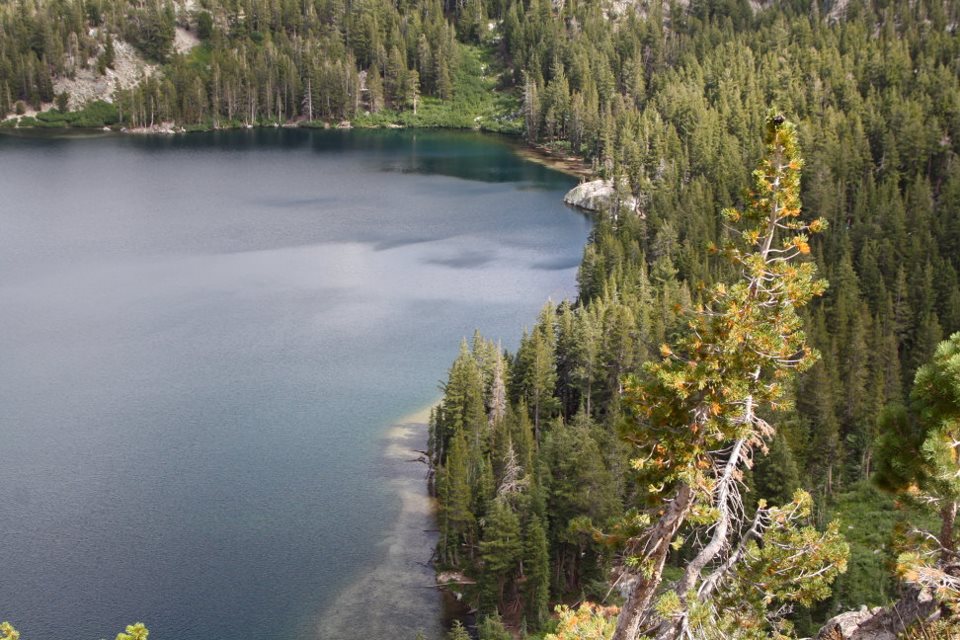
Some of my favorite things to see in the Sierra region are the lakes. Two in particular blew my socks off, as did Muir’s. The first that both he and I saw heading Eastward, him on July 26, 1869, and I on September 4, 2011, was Lake Tenaya:


“The largest of the many glacier lakes in sight, and the one with the finest shore scenery, is Tenaya, about a mile long, with an imposing mountain dipping its feet into it on the south side, Cathedral Peak a few miles above its head, many smooth swelling rock-waves and domes on the north, and in the distance southward a multitude of snowy peaks, the fountain-heads of rivers…”

And on July 27: “Up and away to Lake Tenaya—another big day, enough for a lifetime. The rocks, the air, everything speaking with audible voice or silent; joyful, wonderful, enchanting, banishing weariness and sense of time…
The lake was named for one of the chiefs of the Yosemite tribe. Old Tenaya is said to have been a good Indian to his tribe. When a company of soldiers followed his band into Yosemite to punish them for cattle-stealing and other crimes, they fled to this lake by a trail that leads out of the upper end of the valley, early in the spring, while the snow was still deep; but being pursued, they lost heart and surrendered. A fine monument the old man has in this bright lake, and likely to last a long time, though lakes die as well as Indians, being gradually filled with detritus carried in by the feeding streams, and to some extent also by snow avalanches and rain and wind. A considerable portion of the Tenaya basin is already changed into a forested flat and meadow at the upper end, where the main tributary enters from Cathedral Peak. Two other tributaries come from the Hoffman Range. The outlet flows westward through Tenaya Cañon to join the Merced River in Yosemite. Scare a handful of loose soil is to be seen on the north shore. All is bare, shining granite, suggesting the Indian name of the lake, Pywiack, meaning shining rock. The basin seems to have been slowly excavated by the sands of years. On the south side an imposing mountain rises from the water’s edge to a height of three thousand feet or more, feathered with hemlock and pine, and huge shining domes on the east, over the tops of which the grinding, wasting, molding glacier must have swept as the wind does today.”


August 8: “The view of the lake from the top is, I think, the best of all. Made sketch of the lake, and sauntered back to camp, my iron-shod shoes clanking on the pavements disturbing the chipmunks and birds. After dark went out to the shore—not a breath of air astir; the lake a perfect mirror reflecting the sky and mountains with their stars and trees and wonderful sculpture, all their grandeur refind and doubled--- a marvelously impressive picture, that seemed to belong more to heaven than earth.”

Another lake Muir enjoyed was Mono Lake, at the end of his travels in the summer of ’69. There he witnessed a native community:

August 21: “Down on the shore of Mono Lake I saw a number of their flimsy huts [insert: I went to Mono Lake and learned that what Muir saw were the temporary summer huts, while the year-round wooden cabins built farther from the lake were much more sturdy] on the banks of streams that dash swiftly into that dead sea, --- mere brush tents where they lie and eat at their ease. Some of the men were feasting on buffalo berries, lying beneath the tall bushes now red with fruit. The berries are rather insipid, but they must be wholesome, since for days and weeks the Indians, it is said, eat nothing else. In the season they in like manner depend chiefly on the fat larvae of a fly that breeds in the salt water of the alke, or on the bit fat corrugated caterpillars of a species of silkworm that feeds on the leaves of the yellow pine. Occasionally a grand rabbit-drive is organized and hundreds are slain with clubs on the alke shore, chased and frightened into a dense crowd by dogs, boys, girls, men and women, and rings of sage brush fire when of course they are quickly killed. The skins are made into blankets. In the autumn the more enterprising of the hunters bring in a good many deer, and rarely a wild sheep from the high peaks. Antelopes used to be abundant on the desert at the base of the interior mountain ranges. Sage hens, grouse, and squirrels help to vary their wild diet of worms, pine nuts, and good bread and good mush are all made from acorns and wild rye. Strange to say, they seem to like the lake larvae best of all."

See all that black lining the shores? Those are the flies whose larvae the Paiute people ate, and which the seagulls currently eat.

"The desert around the lake is surprisingly flowery...."

"Opposite the mouth of the cañon a range of volcanic cones extends southward from the lake, rising abruptly out of the desert like a chain of mountains. The largest of the cones are well-formed crater, and all of them are evidently comparatively recent additions ot the landscape. At a distance of a few miles they look like heaps of loose ashes that have never been blest by either rain or snow, but for a’ that and a’ that, yellow pines are climbing their gray slopes, trying to clothe them and give beauty for ashes. A country of wonderful contrasts. Hot deserts bounded by snow-laden mountains--- cinders and ashes scattered on glacier-polished pavements--- frost and fire working together in the making of beauty. In the lake are several volcanic islands, which show that the waters were once mingled with fire.”

The volcanic mountains South of and just beyond the lake:

The volcanic islands:

I don’t think Mr. Muir ever fancied living in the arid turf east of the Sierra, though he clearly appreciated, enjoyed, and learned from it. I prefer the green as well, but there is something about Mono Lake that makes it a peculiar medium between dry and forested. Here, in the desert, is a gigantic body of water, teeming with life, with verdant creek basins where the snow runs off into the lake, and with the loden, pine-laden, ivory-topped Sierra Nevada as a backdrop.


Mono Lake is also exceptional in that it is the second oldest lake in the country, it’s 2.5 times saltier than the ocean (which forms tufa, the incredible calcium deposit structures you see emerging from the lake), and it’s a high traffic area for various breeding and resting birds. And as Muir said, the flowering brush is plentiful and brilliant. Fortunately, after the damage the city of Los Angeles did to its water supply, it is being restored and shows no signs of being anything short of wild, beautiful, and unusual.

Tuesday, September 13, 2011

Blessed Unrest

"When Canada tried to force the Inuit into encampments on Baffin Island in the 1950s, one Inuit grandfather would have nothing to do with it. 'The family took away all of his weapons and all of his tools, hoping that would force him into the settlement. Did it? No. In the middle of an Arctice night with a blizzard blowing, the old man slipped out of the igloo into the darkness and simply pulled down his caribou hide and sealskin trousers and defecated into his hand. As the feces began to freeze he shaped it into the form of a blade. As the shit took shape he put a spray of saliva along one leading edge to create a sharp edge. When the implement was finally created from the cold, he used it to kill a dog. He skinned the dog and used the skin of the dog to improvise a harness and used the rib cage of the dead dog to improvise the sled, harnessed an adjacent dog, and then with shit-knife in belt disappeared over the ice flow.' The elder returned alive and well in the spring. Forty years later, the Canadian government relented and returned the Inuit lands, creating Nunavut, a territory the size of western Europe."

Paul Hawkens, Blessed Unrest, with inner quote by Wade Davis, The Ethnosphere and the Academy

Sunday, September 11, 2011

John Muir

After a one-month hiatus from pledging this and that, I have a plan for this blog the following month: to explore the Sierra by learning about the flora and fauna, document what I see with photos, continue my very first pledge to read John Muir’s My First Summer in the Sierra, and share what I discover on this blog. I visited many of the places John Muir marveled at in his book and will provide photos, information, and his writings about them. Today is dedicated to all the meadows out there, particularly Tuolumne, the most beautiful meadow I’ve ever encountered.

 Taken September 4, 2011. You can see that it's located towards the Eastern side of the Sierras, at about 8600 feet.

And here are John Muir’s musings from August 9, 1869:
 “The big Tuolumne Meadows are flowery lawns, lying along the south fork of the Tuolumne River at a height of about eighty-five hundred to nine thousand feet above the sea, partially separated by forests and bars of glaciated granite. Here the mountains seem to have been cleared away or set back, so that wide-open views may be had in every direction… This is the most spacious and delightful high pleasure-ground I have yet seen. The air is keen and bracing, yet warm during the day, and though lying high in the sky, the surrounding mountains are so much higher, one feels protected as if in a grand hall. Mts. Dana and Gibbs, massive red mountains, perhaps thirteen thousand feet high or more, bound the view on the east, the Cathedral and Unicorn Peak, with many nameless peaks, on the south, and Hoffman Range on the west, and a number of peaks unnamed, as far as I know, on the north. One of these last is much like the Cathedral.”

See the picture above to spot the reddish mountains of Dana and Gibbs. 

“The grass of the meadows is mostly fine and silky, with exceedingly slender leaves, make a close sod, above which the panicles of minute purple flowers seem to float in airy, misty lightness, while the sod is enriched with at least three species of gentian and as many or more of orthocarpus, potentilla, ivesia, solidago, pentstemon, wither their gay colors—purple, blue, yellow, and red--- all of which I may know better ere long. A central camp will probably be made in this region.”


I spotted a couple of prairie dogs scampering through these grasses. They took a moment of their busy afternoon to stare back at me. Can you make them out? Of course they blend in very well…

As I was there a month later, I didn’t catch any of the wildflowers, but here are some photos of each that Muir mentions that I found on the internet:
 Orthocarpus, aka Owl's Clover:
Potentilla:

Ivesia:
Solidago:

Pentstemon:
Muir wrote of meadows in general: “I found three kinds of meadows: (1) Those contained in basins not yet filled with earth enough to make a dry surface. They are planted with several species of carex, and have their margins diversified with robust flowering plants such as veratrum, larkspur, lupine, etc. (2) Those contained in the same sort of basins, once lakes like the first, but so situated in relation to the streams that flow through them and beds of transportable sand, gravel, etc. that they are now high and dry and well drained. This dry condition and corresponding difference in their vegetation may be caused by no superiority of position, or power of transporting filling material in the streams that belong to them, but simply by the basin being shallow and therefore sooner filled. They are planted with grasses, mostly fine, silky, and rather short-leaved, Calamagrostis and Agrostis being the principal genera. They form delightfully smooth, level sods in which one finds two or three species of gentian and as many purple and yellow orthocarpus, violet, vaccinium, kalmia, bryanthus, and lonicera. (3) Meadows hanging on ridge and mountain slopes, not in basins at all, but made and held in place by masses of boulders and fallen trees, which, forming dams one above another in close succession on small, outspread, channelless streams, have collected soil enough for the growth of grasses, carices, and many flowering plants, and being kept well watered, without being subject to currents sufficiently strong to carry them away, a hanging or sloping meadow is the result. Their surfaces are seldom so smooth as the others, being roughened more or less by the projecting tops of the dam rocks or logs; but at a little distance this roughness is not noticed, and the effect is very striking, bright green, fluent, down-sweeping flowery ribbons on gray slopes… How wonderful must be the temper of the elastic leaves of grasses and sedges to make curves so perfect and fine. Tempered a little harder, they would stand erect, stiff and bristly, like strips of metal; a little softer, and every leaf would lie flat. And what fine painting and tinting there is on the glumes and pales, stamens and feathery pistils. Butterflies colored like the flowers waver above them in wonderful profusion, and many other beautiful winged people, numbered and known and loved only by the Lord, are waltzing together high over head, seemingly in pure play and hilarious enjoyment of their little sparks of life. How wonderful they are! How do they get a living, and endure the weather? How are their little bodies, with muscles, nerves, organs, kept warm and jolly in such admirable exuberant health? Regarded only as mechanical inventions, how wonderful they are! Compared with these, Godlike man’s greatest machines are as nothing.”

I agree!

It is pretty apparent that Tuolumne Meadows is classified as a (2) meadow: in a basin, dry with a well-defined and well-formed river/creek running through it (Tuolumne River to be exact), and covered in grasses. But leaving behind names and classifications, it’s simply one of the prettiest phenomena on the planet. Enjoy the photos and I hope you can get yourself there someday, too.